Vibe Coding: More Than a Flame War
One of the most hyped AI topics today is vibe coding. For those who are not in the loop: it’s when people who cannot write code create software anyway. You explain to your ChatGPT what you need, and it writes the code for you.
Some people say the resulting code is garbage and nothing serious can work this way. Others say it works even better — and costs orders of magnitude less. This argument is not just another internet flame war. It is, I would say, a fundamental question. Because if AI can really build software on its own, it can build anything. What in the modern world doesn’t have software underneath it?
Startups went first
The first to rush into vibe coding were startup founders. The logic was simple: yes, the code is probably bad, but we have no money for good code anyway. So it’s either this code or no code at all.
Vibe-coded startups appeared in huge numbers, and some of them became successful. But this didn’t remove the condescending attitude. You know the tone: “Okay, something works for you now, but when you get real users — something will definitely break.”
Maybe. I wrote in my previous articles how I built an ecosystem of products and my own internal tool this way, so you can guess my position in this argument. But honestly, the skeptics are not entirely wrong either — the code quality question is real. It’s just not the interesting question anymore.
Big companies are watching
Large companies are more careful for now. From time to time, news breaks that some corporation somewhere laid off a few thousand developers and replaced them with AI. But this all happens mostly “over there,” across the ocean. In Ukraine, I haven’t heard of anything like that yet — either the market is smaller, or people just keep quiet about it.
But here is the thing: AI that writes code is not necessarily about someone losing their job. There is another approach, and I find it much more interesting.
Let your non-IT people vibe-code
Think about it this way. If Claude Code can write a product for marketers when a startup founder asks it to — why can’t it write that product directly for the marketer? For their specific tasks, their specific workflow, their specific weirdness that no off-the-shelf product ever covers.
And then the next question: why should a company buy that product at all, if its own employees can create one that is no worse — for free?
This is not a theoretical construction. Some companies already give their non-IT specialists the ability to vibe-code internal tools. The marketer builds their own campaign tracker. The analyst builds their own report generator. The support person builds the exact dashboard they always wanted and never got from the ticket system.
There is a historical precedent for this, by the way. Spreadsheets. Fifty years ago, calculating a financial model was a job for a programmer and a mainframe. Then Excel arrived, and suddenly every accountant became, in a sense, a programmer — writing formulas, building models, automating calculations. Nobody calls it programming. It’s just work. I suspect that in ten years, “I described my tool to AI and it built it” will sound exactly as unremarkable as “I made a spreadsheet for it” sounds today. In this context, you can also learn about navigating challenges when your developer disappears.
My experience
I work with vibe coding from both sides: in my own startups, and with a large company that lets its non-IT employees vibe-code. So I’ve seen this from the founder’s chair and from inside a corporation.
My opinion: it works already, right now, and it will certainly keep working. Not perfectly, not for everything, and not without supervision — but the direction is unmistakable.
I don’t know how this ends for the software industry. Maybe the pessimists are right, and we will drown in unmaintainable code. Maybe the optimists are right, and software will finally become as personal as a spreadsheet. Most likely, something third that nobody predicted.
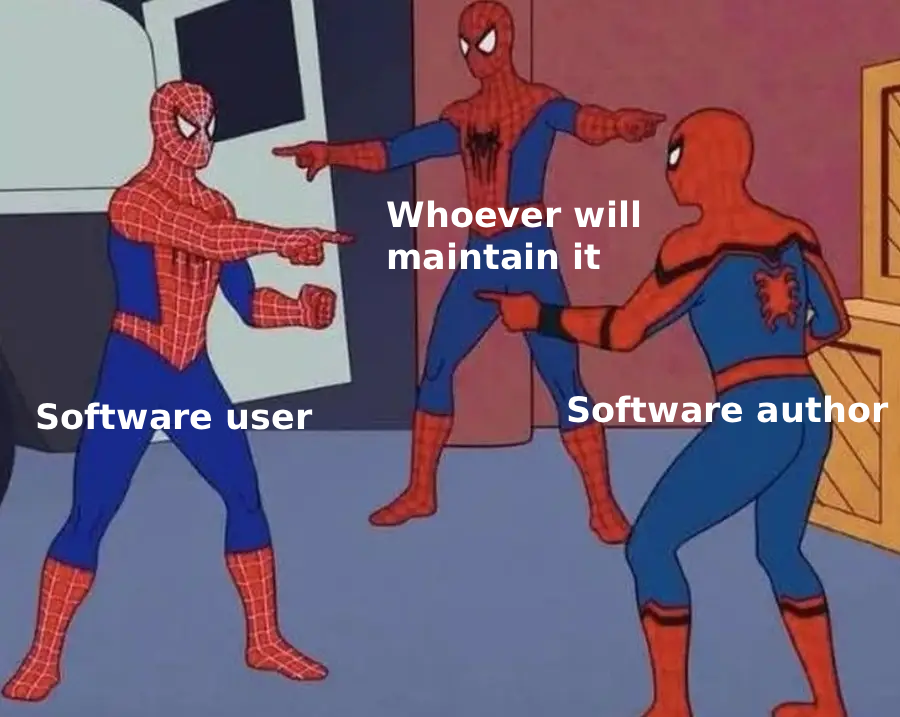
But one thing I know for sure: the line between “software user” and “software author” is melting before our eyes. For decades, these were two different castes — the people who use programs and the people who create them. That border is disappearing now, quietly, one vibe-coded internal tool at a time.
And when a border like that disappears, much more changes than it seems.
Read also on Medium