The Best Time to Be a Non-Technical Founder
How AI let me finally build the products I had been carrying in my head for years.
The folder of ideas
I think every founder has one. A folder, a note on the phone, or just a corner of the mind where ideas live. Not random ideas, but good ones. Ideas you have checked against the market, discussed with people from the industry, and even partly designed in your head.
And then the ideas just sit there. For years.
Why? For me, the reasons were simple:
- *I am a non-technical founder.* I can read code and I understand how products work, but I cannot sit down and build a platform myself.
- *Development is expensive.* A modest marketplace or a service with search, matching and notifications takes a development team months. Multiply that by the number of ideas, and the budget turns into science fiction.
- *A technical co-founder is not a universal answer.* Finding a strong technical partner for each idea is even harder than finding money for it. In a niche market, the search gets harder, not easier.
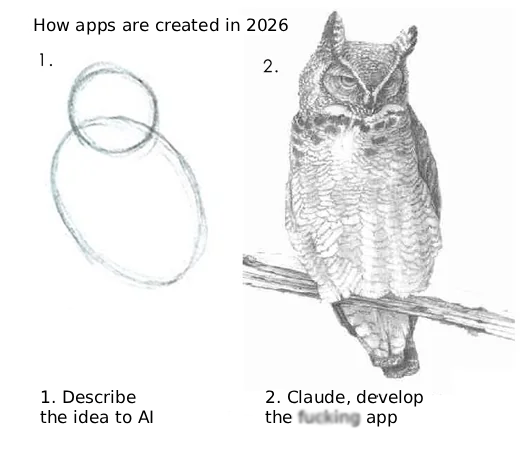
So, honestly, the situation of a non-technical founder until recently looked like this: you can have ten validated ideas, but you can afford to build one. Maybe.
What changed
You know what changed. AI happened, and for me specifically, AI-assisted coding happened.
I don't want this to sound like another "AI will replace developers" post. I don't believe it will, at least not in the way the headlines describe. But from my own experience, I can say this: AI coding tools moved the border of what a non-technical founder can build with his own hands. Not slightly. Dramatically.
Things that used to need a team and a budget now need an idea, product thinking, patience and a laptop. You still have to understand your market. You still have to design the logic of your product, test it, fix it, and fix it again (believe me, there is a lot of fixing). AI doesn't remove the work. It removes the barrier.
For me, it meant one specific thing: the folder of ideas finally opened.
From ideas to products
Today I am building an ecosystem of products in a niche industry, one that is very far from IT and that big platforms usually ignore. There is a marketplace with advanced search, moderation and mobile apps. There is a service that connects people with providers and makes a non-transparent market a bit more transparent. And there is an AI agent that monitors many scattered sources every day and turns them into one clean feed, which is similar to the integrated solution discussed in The SaaS Zoo.
A few years ago, each of these would have been a separate startup with its own budget and its own search for a technical co-founder. Now it is one small team and a completely different economy of building.
Instead of a conclusion
There is a popular opinion that this is the worst time to start something, because AI makes every market crowded. I would argue with that. For a non-technical founder with real domain knowledge and a folder of ideas, there has never been a better time.
The ideas are finally becoming products, and I'll keep documenting the journey for as long as I have electricity and internet access.